Swing-Tree
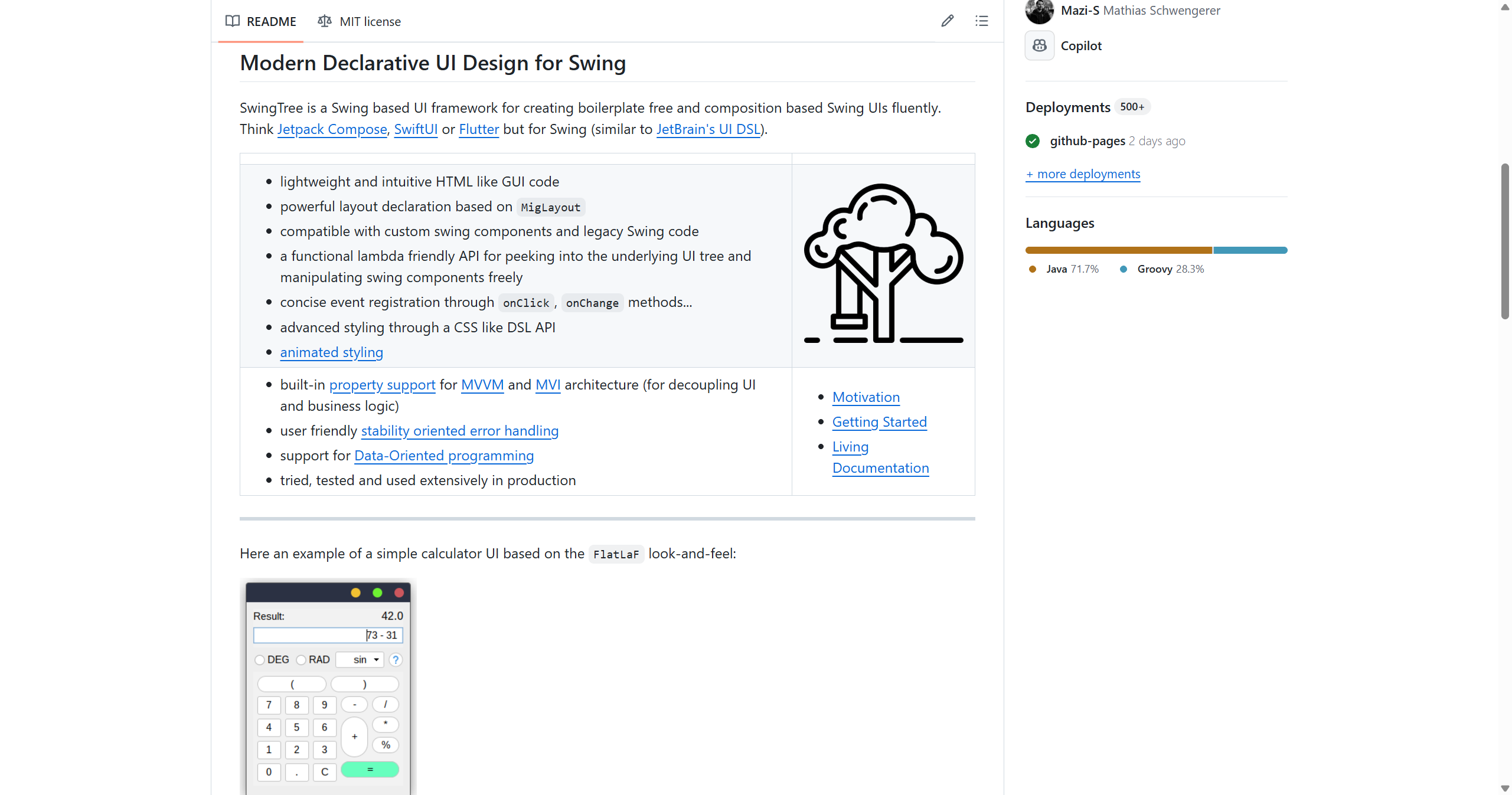
Status: Production-ready
Java Version: 8+
Learning Curve: Easy-Moderate
Last Release: 1.0.0 (2026-09-18)
Swing-Tree GitHubSwing-Tree is a declarative UI DSL for Swing that lets developers describe desktop interfaces as a fluent component tree instead of wiring together verbose imperative code. The library builds directly on standard Swing, uses MigLayout for expressive layout declarations, and keeps most of its API on a single
UI class, which makes small views and larger forms read naturally. Beyond basic component builders, Swing-Tree also includes styling, animation, event hooks, and support for property-driven MVVM-style patterns through the wider Global TCAD ecosystem. The project is actively maintained and now has a stable 1.0 release, making it a practical option for teams that want to modernize Swing development without replacing their existing desktop stack. It is best suited for Java desktop applications that still rely on Swing but want a more concise, composable authoring model.
Code Example
            import javax.swing.JPanel;
            import swingtree.UI;

            public class HelloSwingTree {
                public static JPanel createView() {
                    JPanel panel = new JPanel();

                    UI.of(panel).withLayout("wrap 1, insets 12")
                        .add(UI.label("Hello, Swing-Tree!"))
                        .add(UI.textField("Jane Doe"))
                        .add(UI.button("Say Hi")
                            .onClick(it -> System.out.println("Welcome to Swing-Tree!")));

                    return panel;
                }
            }